Cyber Threat Intelligence
AI in the Hands of Cyber Threat Actors
Nine months after our January 2026 edition, AI still multiplies what threat actors can do without changing what they are after. What has changed can now be measured in time: exploitation precedes the patch by a week, and agents can run an intrusion in under ten hours.
This update tests the January assessments against the facts and shows which risk parameters AI actually moves.
They trust us





Who This Report Is For
This report was designed for CISOs setting patching and response priorities, for risk managers and compliance officers integrating AI into the risk map, for executive committees who need a factual reading of the threat, and for the IAM, SOC and AI teams now in charge of governing agents.
01
The exploitation and response timeframes to build into the security roadmap, with indicators to track them.
02
A rated reading of what is observed, assessed or prospective, and of how NIS2, DORA, GDPR and the AI Act apply to incidents caused by an agent.
03
A factual reading of the AI threat, to integrate into the existing risk map rather than treat as a separate topic.
04
Concrete rules for governing agents as privileged identities and bringing AI logs under security monitoring.
The report draws on more than 180 open sources, with a cutoff of September 30, 2026. Every judgment is rated on the probability and confidence scales recommended by FIRST.
What Has Changed Since January 2026
Espionage, fraud, extortion and influence remain the purposes. What has shifted is how operations are executed and what they target. This edition highlights four developments:
01
Agentic Execution
Agents now chain entire intrusion sequences without operator validation between steps.
02
The Exploitation Window
Exploitation now precedes the patch by one week on average.
03
AI as a Target
Models, keys and connected assistants have become assets that attackers steal, resell and encrypt.
04
Defense Maturity
The documented gap is organizational, not a structural advantage for the attacker.
Agentic Execution
Less Oversight, Less Time
< 10 h
Duration of an intrusion orchestrated by agents, against around two weeks estimated for human operators (Palo Alto Networks, single case)
−7 days
Average gap between exploitation and patch release in 2025, against −1 day in 2024 (Google, cited by Mandiant)
88%
Share of exploitations of vulnerabilities with a public proof of concept occurring within 48 hours (CrowdStrike)
Vulnerabilities
The Patch No Longer Comes First
AI as an Exposure Surface
The AI You Deploy Is Now Worth Stealing
Quantification
No AI Coefficient in the Risk Model
Six Questions on the Report “AI in the Hands of Cyber Threat Actors”
Autonomous sequences are documented, and incidents in evaluation environments have shown the approach is technically feasible against real organizations. No threat actor, however, has been observed deploying a complete autonomous pipeline against real targets in vendor telemetry. That telemetry does not cover self hosted models.
Not on the available evidence. The widely cited 89% increase in attacks by AI enabled adversaries measures actors who use the tools, not a causal effect. The inflection the corpus does document is the compression of time.
Within days, and before the patch. Exploitation precedes the patch by seven days on average, and 88% of exploitations of vulnerabilities with a public proof of concept happen within 48 hours.
Like a privileged one. An agent with write permissions needs its own identity, a named owner, least privilege, logging and an immediate stop. In a Wavestone panel of around thirty large organizations, around 15% apply IAM to their AI systems, and fewer than one in ten forward the logs of critical AI uses to the SOC.
That is not established. Their vulnerability discovery and exploitation capabilities have been demonstrated in evaluation, but no offensive use by a threat actor is documented. The effect observed among attackers comes through scaffolding and publicly accessible models.
Not across the board. Citalid adjusts a single parameter at this stage, the susceptibility of exposed assets. The other effects are treated as trajectories to stress test rather than certainties to price.
Get Started Now
What You Read Here, the Citalid Platform Quantifies
Access our report now
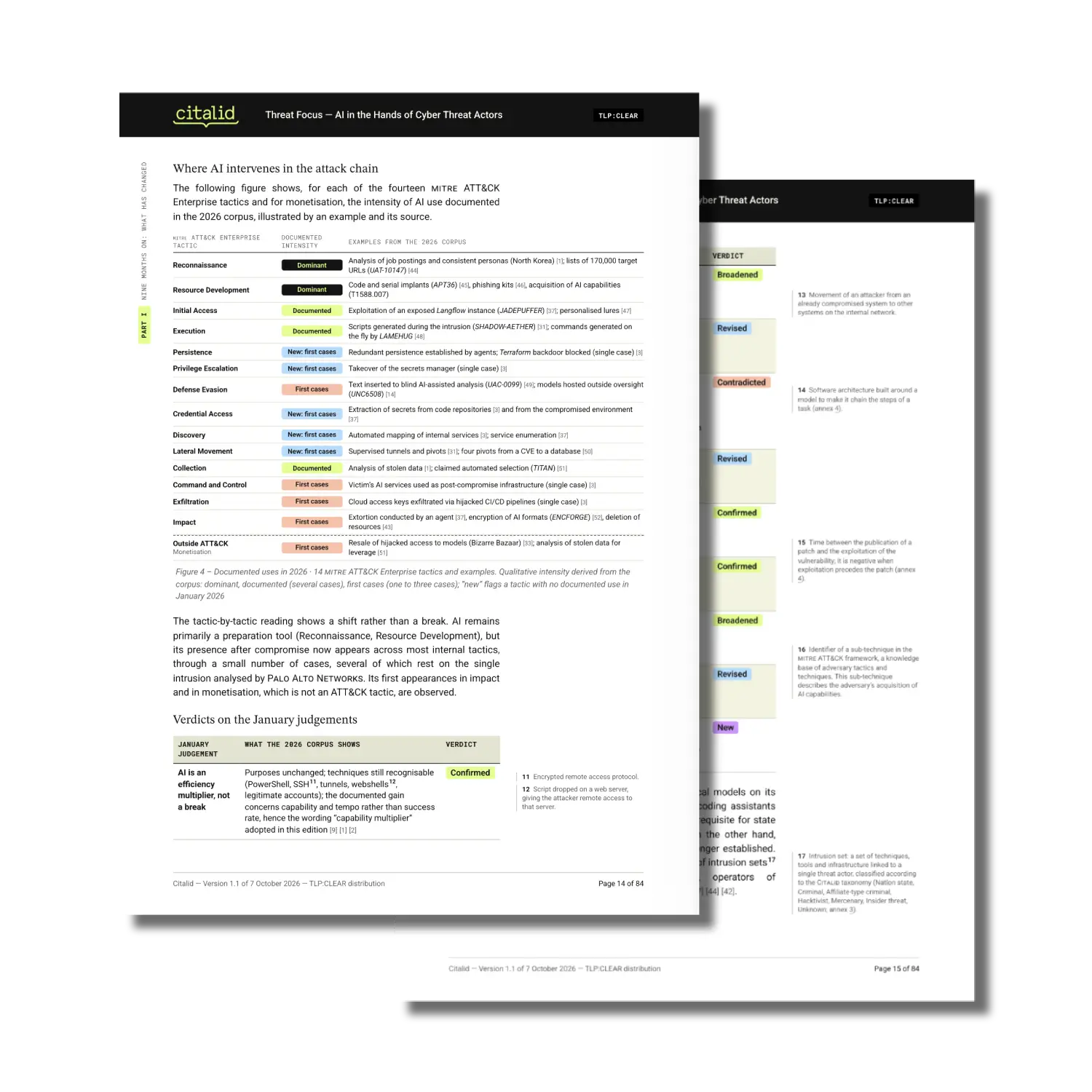
84 pages testing nine months of incidents against the January 2026 assessments: agents chaining intrusions, an exploitation window that now opens before the patch, the AI estate as a target, and what all of it changes in a risk model.